
Elon Musk says AI could surpass human intelligence within five years
Musk made the remark on X while responding to entrepreneur and author Peter H. Diamandis, who argued that human progress is often limited not by intelligence itself but by access to resources and tools.


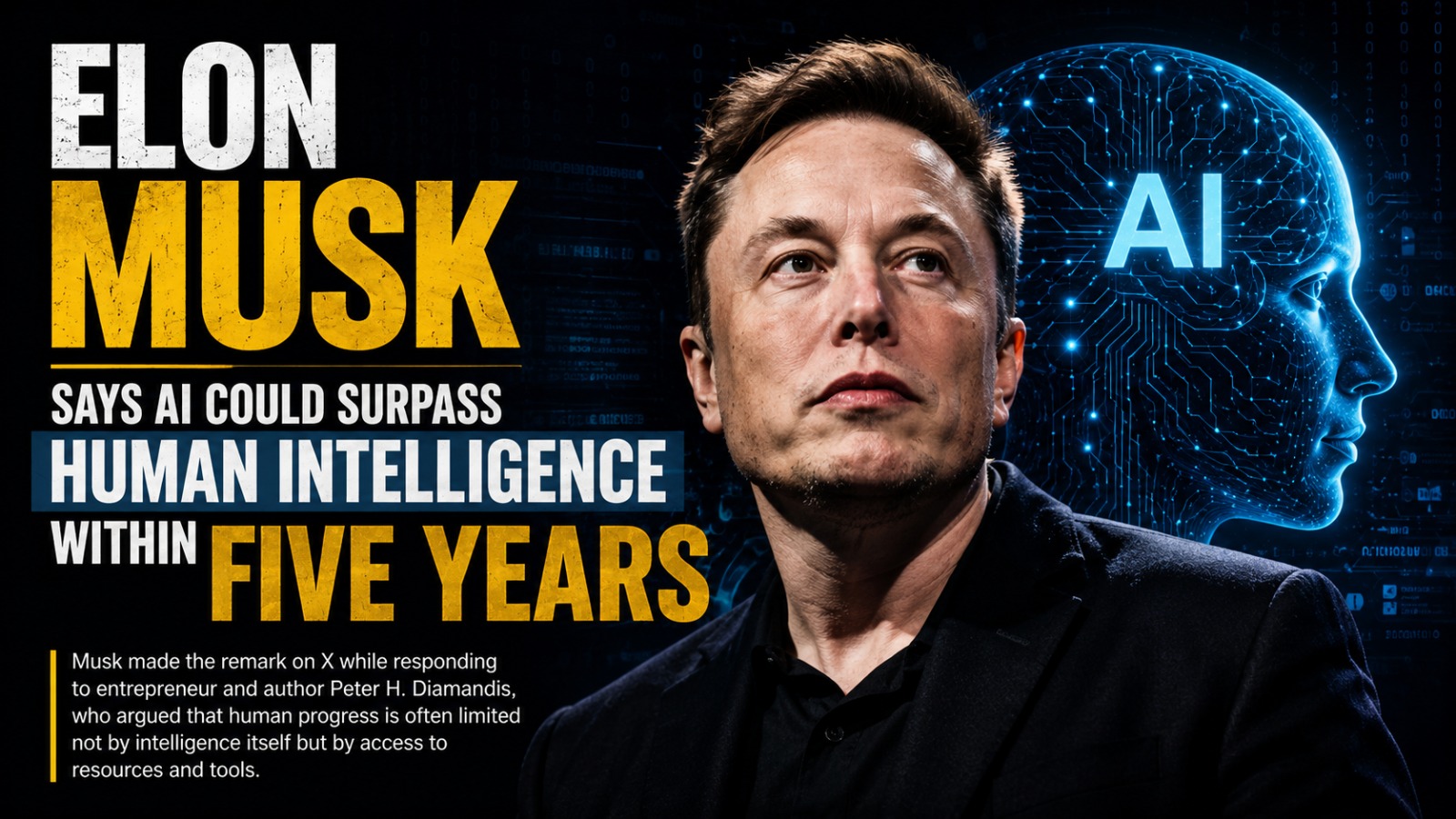
MUMBAI: The race between man and machine may be entering its final lap, at least if Elon Musk is right. The Tesla and xAI chief has reignited the debate over artificial intelligence after predicting that AI could exceed the combined intelligence of all humans within the next four to five years.
Musk made the remark on X while responding to entrepreneur and author Peter H. Diamandis, who argued that human progress is often limited not by intelligence itself but by access to resources and tools.
“AI probably exceeds the sum of all human intelligence in 4 or 5 years,” Musk wrote, offering his latest forecast on the pace of technological advancement.
The prediction adds to Musk’s long-running commentary on artificial intelligence, a field he has alternately described as humanity’s greatest opportunity and one of its biggest risks. As AI models become more capable and increasingly integrated into everyday life, Musk believes the technology is approaching a transformational tipping point.
Beyond intelligence, Musk painted a future powered by what he called “amazing abundance”, where artificial intelligence and robotics dramatically improve productivity while lowering the cost of goods and services.
A key pillar of that vision is Tesla’s humanoid robot programme, Optimus. Musk has repeatedly argued that robots could eventually handle repetitive, physically demanding and hazardous tasks across sectors ranging from manufacturing and logistics to construction. He has even suggested that robotics could one day become a bigger business opportunity for Tesla than electric vehicles.
The implications, he argues, stretch far beyond factory floors. Greater automation and AI-driven efficiency could challenge traditional economic models and reshape the nature of work itself. Earlier this year, Musk floated the idea of a future marked by “universal high income”, where technological productivity helps raise living standards irrespective of conventional employment.
Not everyone shares the same timeline. While rapid advances in AI and robotics have fuelled optimism among technology leaders, many researchers caution that achieving human-level or superhuman intelligence remains a complex scientific challenge with significant technical hurdles still to overcome.
For now, Musk’s latest forecast adds another bold prediction to an industry already moving at breakneck speed and keeps the question alive: how close is humanity to creating something smarter than itself?
Discussion
No comments yet. Be the first to share your thoughts!