

AVGC Sector to Need 2 Million Professionals by 2030
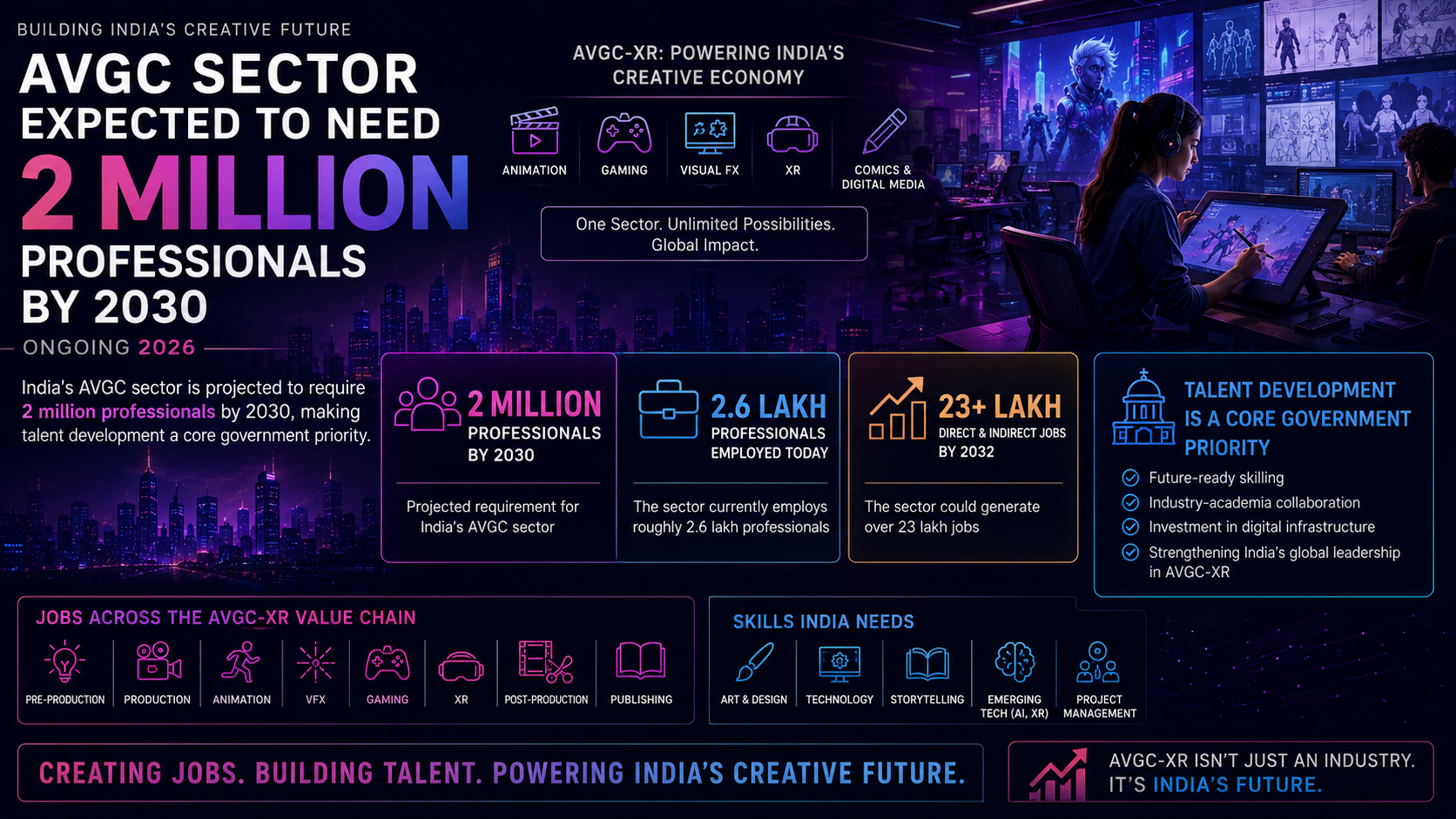
India's AVGC sector currently employs 2.6 lakh professionals but is projected to need 2 million by 2030, creating an urgent talent development priority for government and industry.


The talent gap that defines India's AVGC challenge
Numbers can be instructive, but occasionally they are genuinely startling. India's AVGC sector currently employs approximately 2.6 lakh professionals — a workforce that represents years of educational investment, studio capacity building, and industry maturation. By 2030, the sector is projected to require 2 million professionals. That is a near-eight-fold increase in less than five years. More broadly, industry estimates suggest the sector could generate over 23 lakh direct and indirect jobs by 2032.
The talent gap implied by these figures is not a distant, theoretical concern. It is a present and growing constraint on India's ability to capture the global AVGC market share that its other competitive advantages — cost, technical capability, cultural diversity, English proficiency — would otherwise position it to claim. Studios are already reporting difficulty in recruiting the volume of qualified candidates they need, and the problem is expected to intensify significantly as the industry scales.
Understanding the gap
The talent shortage in India's AVGC sector has both quantitative and qualitative dimensions. On the quantitative side, the sheer number of trained professionals that need to enter the workforce each year to meet 2030 projections requires a transformation in the scale and accessibility of AVGC education. Current programmes — even combined across all private institutions, public universities, and vocational training centres — are not producing graduates at the required rate.
The qualitative dimension is equally challenging. Many graduates enter the workforce with skills that partially but not fully match what studios require. Soft skills, collaborative workflow experience, familiarity with current industry software, and the ability to work within structured production pipelines are consistently cited by employers as gaps that classroom-based training alone does not adequately address. The mismatch between educational output and industry requirement is a structural problem that requires structural solutions.
Government and industry responses
Recognition of the talent development challenge has catalysed significant policy responses. The Union Budget 2026–27's allocation of ₹250 crore for AVGC Content Creator Labs in 15,000 schools and 500 colleges is the most direct national-level intervention — aimed at seeding AVGC awareness and basic skills at the point of secondary education rather than waiting for students to choose specialist post-graduate programmes. The Indian Institute of Creative Technologies in Mumbai and Tamil Nadu's planned Centre of Excellence in Chennai represent institutional responses to the quality dimension of the talent gap.
Industry is also investing in solutions — through apprenticeship programmes, in-house training academies, and partnerships with educational institutions to co-develop curricula. Netflix's Eyeline Studios hub in Hyderabad will contribute to the talent ecosystem through professional development, international exposure, and the knowledge transfer that comes from working on global productions. Closing the 2-million-professional gap by 2030 will require all of these interventions working in concert — and perhaps some that have not yet been invented.
Discussion
No comments yet. Be the first to share your thoughts!