
The Future of Learning: Tata and Harley’s new methods of Training
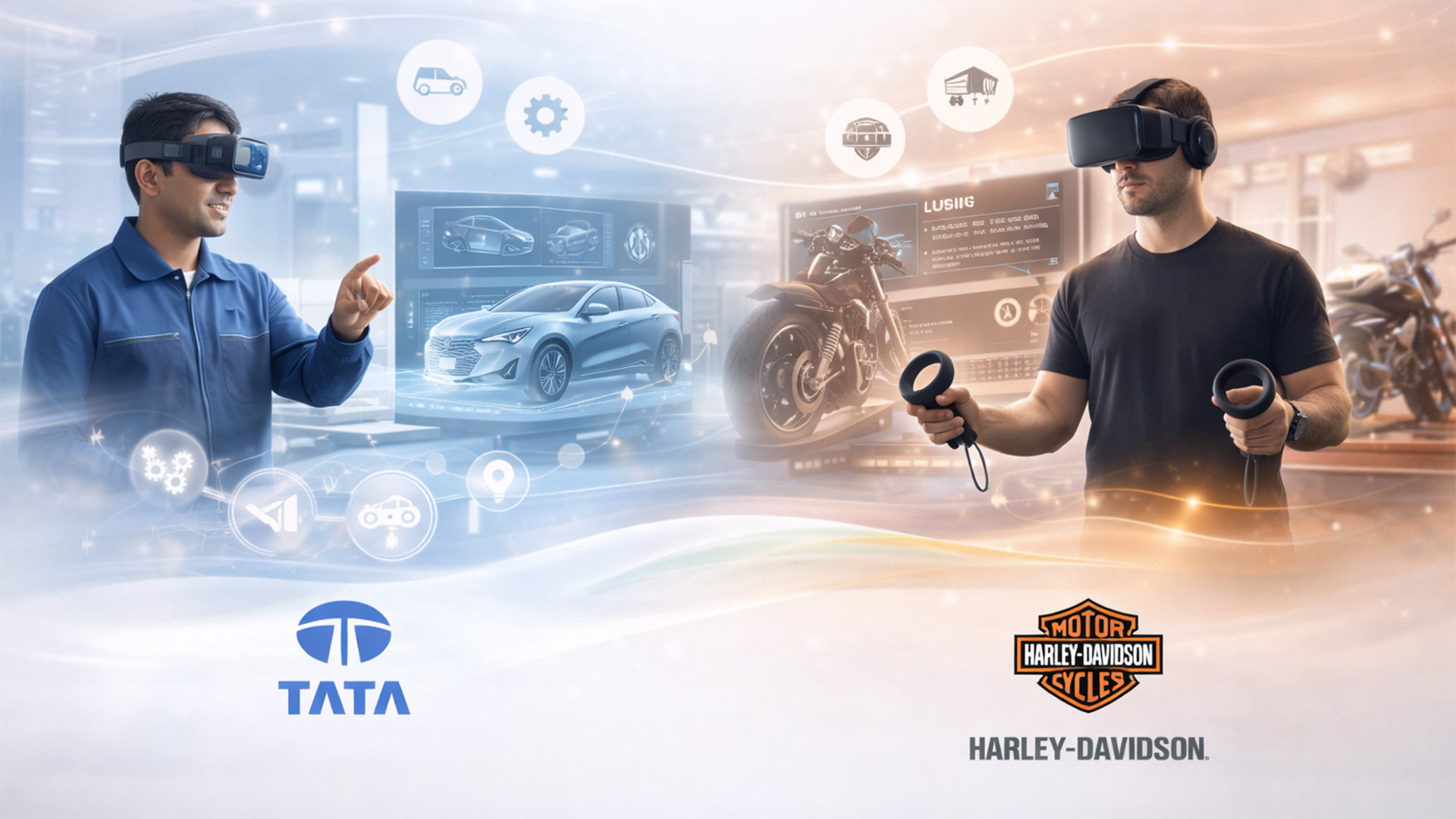
The way we learn job skills is changing dramatically, and is now being adopted in the most unlikely of places: Tata Consultancy Services and Harley-Davidson. Both organizations are using Augmented Reality (AR) and Virtual Reality (VR) technologies to train their employees in ways that were impossible just a few years ago. From complex software troubleshooting to motorcycle maintenance, immersive technologies are making professional training more effective and accessible than ever before.


Why isn’t Traditional Training Enough Anymore?
Think about how you learned your current job skills. Chances are, it involved sitting through lengthy presentations, reading thick manuals, or watching someone else demonstrate tasks you couldn't practice yourself. This traditional approach has serious limitations: it's expensive to scale, often boring for learners, and doesn't provide hands-on experience until you're already on the job.
The problem is exacerbated when dealing with complex or dangerous scenarios. How do you train someone to handle a critical system failure without actually breaking expensive equipment? How do you teach proper safety procedures without putting people at risk? AR and VR solve these problems by creating controlled environments where employees can practice skills, make mistakes, and learn from consequences without any risk or significant losses. Instead of just reading about procedures, trainees can actually perform them virtually, building muscle memory and confidence before ever touching actual equipment.
Tata's Digital Transformation of IT Training
Tata Consultancy Services, one of the world's largest IT services companies, has embraced VR training to address the challenge of rapidly upskilling their massive workforce. With over 600,000 employees globally, traditional training methods simply couldn't scale effectively or keep pace with rapidly evolving technology. To combat this, the company developed VR training modules that immerse employees in simulated work environments where they can practice complex problem-solving scenarios. Instead of learning about cloud computing or cybersecurity through abstract presentations and boring modules, employees can work through realistic simulations that mirror actual client situations they'll encounter.
What makes this particularly effective is the ability to repeat scenarios until mastery is achieved. In traditional training, you might see a demonstration once and hope you remember it when needed. With VR, trainees can practice the same scenario dozens of times, each time building confidence and competence. The technology tracks performance, identifies areas where individuals need additional practice, and adapts the learning experience accordingly.
The results have been impressive. Training time has been reduced significantly while retention rates have improved dramatically. Employees report feeling more prepared for real-world challenges, and managers see faster onboarding and better performance from newly trained staff.
Harley-Davidson's Hands-On Revolution
Harley-Davidson has taken a different but equally innovative approach, using AR to revolutionize how technicians learn motorcycle maintenance and repair. Motorcycle mechanics need to understand complex mechanical systems, and traditional training often meant expensive equipment, expert instructors, and the risk of damaging valuable bikes during learning.
The company's AR training system allows technicians to see detailed overlays on actual motorcycles, highlighting specific components and providing step-by-step instructions that appear directly in their field of view. Trainees can disassemble and reassemble engines virtually, learning the proper procedures without risk of damage or injury.
What's particularly clever about Harley's approach is how it bridges the gap between virtual and physical learning. Technicians use AR glasses or tablets to see digital information overlaid on real motorcycles. The system also captures data on common mistakes and areas where technicians struggle, allowing the company to continuously improve their training programs. This creates a feedback loop that makes training more effective over time, benefiting both individual learners and the organization as a whole.
The Impact of AR/VR in the Workspace
Tata and Harley-Davidson are both part of a larger transformation happening across industries. Healthcare professionals are using VR to practice surgical procedures, pilots train in highly realistic flight simulators, and manufacturing workers learn complex assembly processes in virtual environments. Every trainee gets the same high-quality instruction, regardless of location or the availability of expert trainers. Not only does this ensure competency with complex tasks, it also reduces training costs and time-to-productivity for new employees across the globe.
The COVID-19 pandemic accelerated adoption of these technologies as companies needed to continue training while maintaining social distancing. What started as a necessity has become a preferred method for many organizations that discovered the superiority of immersive training over traditional methods.
The Future of Workplace Learning
AR and VR technology is evolving rapidly, with improvements in visual quality, interaction capabilities, and ease of use making it practical for an ever-wider range of training applications. The most exciting development is the emergence of collaborative virtual training environments where employees from different locations can learn together in shared virtual spaces. This combines the benefits of immersive training with the social learning that comes from working with peers.
Companies that embrace these technologies now are positioning themselves with a significant competitive advantage. They can train employees more effectively, onboard new hires faster, and adapt to changing skill requirements more quickly than competitors. The examples set by Tata and Harley-Davidson show that AR and VR training isn't just a futuristic concept—it's a practical solution that's delivering real results today. As the technology continues to improve and costs continue to decrease, immersive training will likely become as common as computer-based learning is today, fundamentally changing how we develop professional skills for the modern workforce.
Discussion
No comments yet. Be the first to share your thoughts!